01
Restore oxygen and circulation
Deploy linear aeration arrays and directional flow systems to support indigenous aerobic communities.
 KUHLKLARECOLOGY · SHANGHAI
PILLAR 02 / AQUATIC ECOSYSTEMS
River remediation, permeable sponge revetments and constructed wetland stewardship.
THE CHALLENGE
Stagnant flows, stormwater shocks, oxygen-depleted sediment and hard channel walls can prevent an urban river from recovering its ecological functions.
THE APPROACH
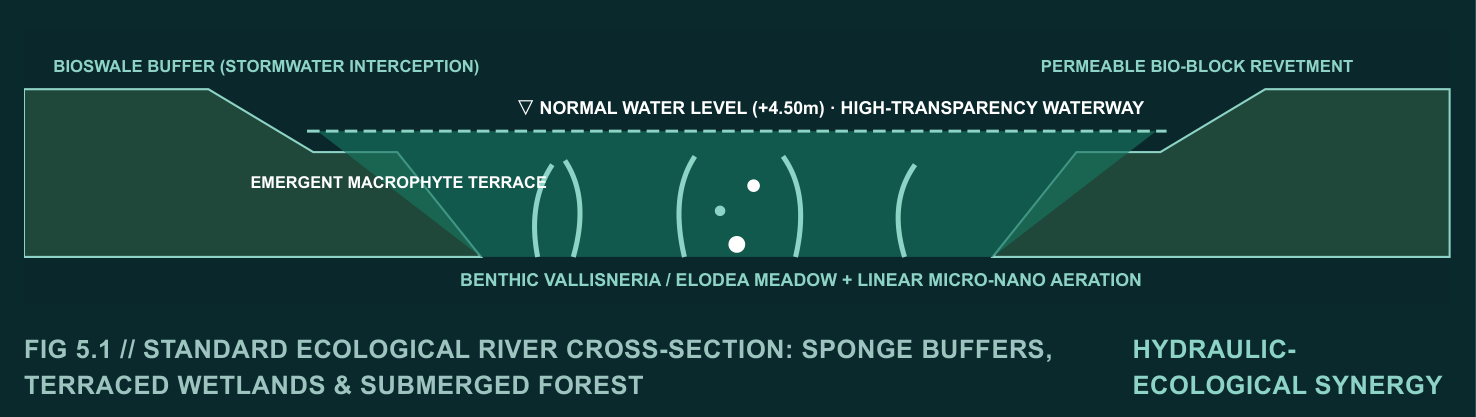
Hydraulic works and ecological habitat are designed together: linear micro-nano aeration and directional circulation restore oxygen, while permeable banks, bioswales and wetland terraces reconnect land and water.
TECHNICAL SCOPE
01
Deploy linear aeration arrays and directional flow systems to support indigenous aerobic communities.
02
Use terraced buffers, permeable ecological blocks and emergent or floating-leaved planting to rebuild habitat.
03
Combine warm-season Vallisneria with cold-tolerant Elodea and Potamogeton, supported by ongoing maintenance.
BROCHURE REFERENCE / TECHNICAL CONTEXT
Selected urban reference: 25 km across four trunk rivers and approximately 820,000 m² of water surface.
The reference combines project-wide specialist OE with direct execution of the Section I core demonstration works; it does not imply execution of every construction package.