01
Profile before intervening
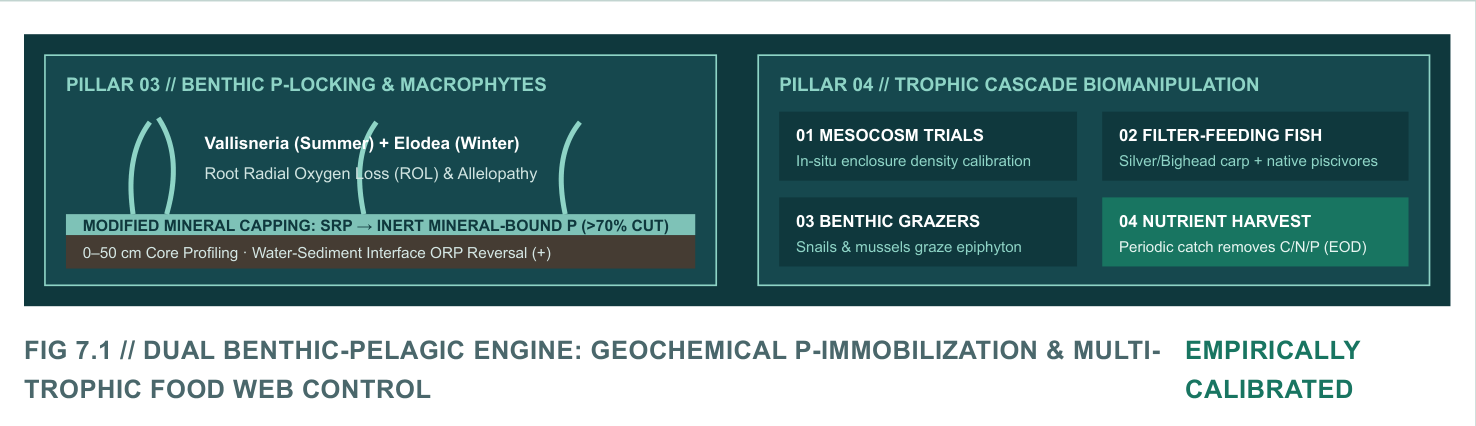
Assess 0–50 cm sediment cores for organic matter, total and bioavailable phosphorus and relevant heavy metals.
 KUHLKLARECOLOGY · SHANGHAI
PILLAR 03 / AQUATIC ECOSYSTEMS
Precision sediment diagnosis, modified mineral phosphorus locking and submerged macrophyte succession.
THE CHALLENGE
External pollution interception alone may leave a large internal nutrient source in anaerobic sediments. Poor light conditions and unstable substrates also constrain submerged plants.
THE APPROACH
Sediment cores define the intervention boundary. Site-matched mineral capping immobilizes reactive phosphorus, while oxygenation and euphotic-zone management support a resilient submerged community.
TECHNICAL SCOPE
01
Assess 0–50 cm sediment cores for organic matter, total and bioavailable phosphorus and relevant heavy metals.
02
Evaluate modified mineral materials and application design using sediment–water interface testing.
03
Coordinate water levels, light availability and seasonal Vallisneria–Elodea succession with ecological construction.
BROCHURE REFERENCE / TECHNICAL CONTEXT
The brochure reports >70% reduction in internal phosphorus release for its mineral-capping and oxygenation approach.
This is a brochure-reported technical outcome, not a guaranteed reduction for every waterbody. Material suitability and field performance need site-specific validation.