01
Audit across disciplines
Review bed levels, weir regulation, bank slopes and planting light requirements alongside hydraulic design teams.
 KUHLKLARECOLOGY · SHANGHAI
PILLAR 05 / AQUATIC ECOSYSTEMS
Independent aquatic Owner’s Engineering and buoy-linked smart watershed operations.
THE CHALLENGE
Civil and hydraulic drawings can overlook biological habitat thresholds, resulting in failed planting, fish mortality or seasonal water-quality rebound after construction.
THE APPROACH
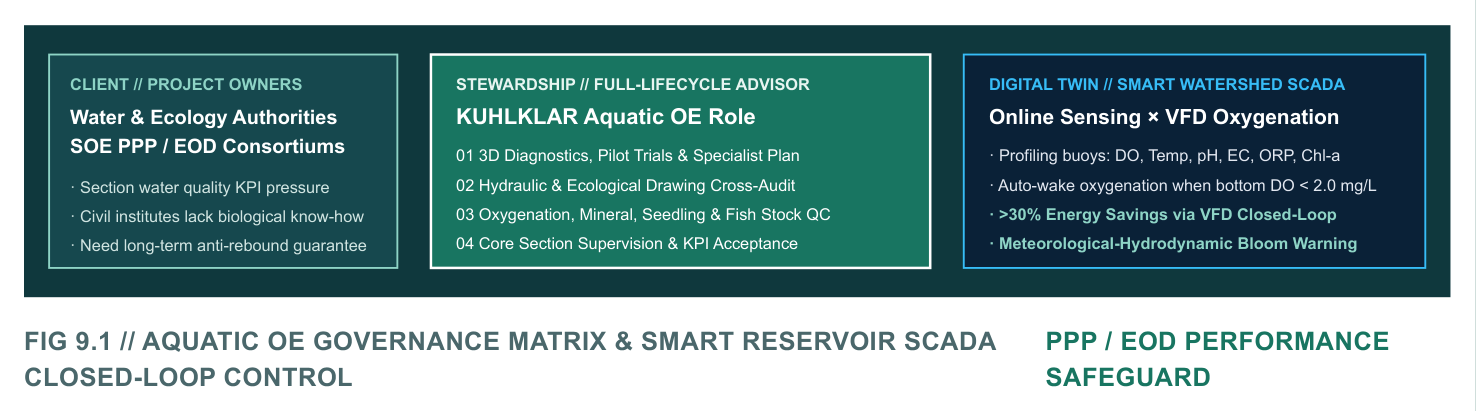
KUHLKLAR provides specialist owner-side technical stewardship from diagnosis and design cross-audit to material and stocking quality control, core-section supervision, acceptance and smart O&M.
TECHNICAL SCOPE
01
Review bed levels, weir regulation, bank slopes and planting light requirements alongside hydraulic design teams.
02
Specify and inspect oxygenation equipment, mineral media, macrophyte vitality and fish stock; supervise critical implementation stages.
03
Link profiling buoys and water-quality telemetry to VFD oxygenation and bloom-risk warning for responsive operations.
BROCHURE REFERENCE / TECHNICAL CONTEXT
The brochure reports >30% energy savings for profiling-buoy-linked, demand-driven VFD oxygenation.
Actual savings depend on the baseline operating mode, equipment sizing and site demand. The cited control example activates oxygenation when bottom DO falls below 2.0 mg/L.